Standby Generator Sizing: How to Choose the Right Capacity for Your Home
Standby generator sizing starts with an electrical load calculation, not your home’s square footage. A qualified electrician totals the running and starting watts of everything you want backed up, adds the surge that motors draw, and matches that number to a generator’s kilowatt rating. Most Pennsylvania homes land somewhere between 14 kW and 26 kW, depending on how much of the house they want covered.
Get the number right and the generator carries your home through a multi-day outage without noticing. Get it wrong and you either overload a unit that shuts itself down at the worst moment, or you pay thousands of dollars for capacity that never gets used. This guide walks through how sizing actually works, what drives it in Pennsylvania homes specifically, and where homeowners most often get it wrong.
Why Sizing Is the Decision Everything Else Depends On
Generator capacity sets the price, the fuel line, the transfer switch, and the pad — so it is the first decision, not a detail sorted out later. Nearly every other number in a generator quote moves when the kilowatt rating moves.
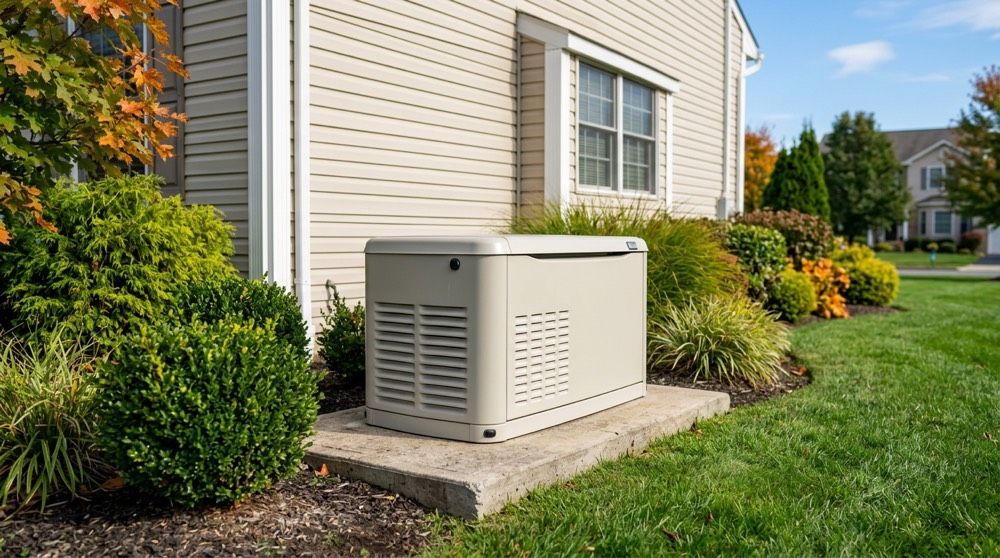
A larger unit needs a larger gas line and draws more fuel per hour. It needs a bigger concrete or composite pad and more clearance from windows and property lines. It may push the transfer switch from a simple whole-house model to a managed one, or reveal that your existing service panel cannot accommodate the tie-in without work. Homeowners who pick a model first and size it afterward tend to discover these knock-on costs mid-project, which is how a straightforward installation turns into a change order. Sizing first keeps the quote honest. If you are still deciding whether whole-home backup is the right investment at all, our complete guide to standby generators for Pennsylvania homeowners covers the ground beneath this one.
How Do You Figure Out What Size Standby Generator You Need?
You determine generator size with a load calculation: an electrician lists every circuit you want powered, records each one’s running and starting wattage, and totals them with the largest motor’s surge included. The result, expressed in kilowatts, points to a specific unit.
The process is methodical rather than complicated. The electrician walks the house and inventories the systems that matter to you — furnace or heat pump, central air, well pump, sump pump, refrigerator and freezer, water heater if it is electric, kitchen circuits, lighting, and any medical equipment. Each gets a running wattage from its nameplate. Then the electrician identifies which loads have motors, because those draw two to three times their running wattage for the first second or two of startup. The total running load plus the single largest starting surge gives the true peak demand. A 10 percent headroom margin is normally added so the generator is not running at its absolute ceiling every time the air conditioner cycles. Square-footage rules of thumb skip all of this, which is why they are unreliable: two 2,400-square-foot homes with different heating systems can need very different generators.
Whole-House Coverage vs. Managed Critical Loads
The two valid approaches are whole-house coverage, which powers essentially everything at once, and managed critical loads, which powers a prioritized set of circuits with a smaller unit. Neither is wrong — they answer different questions about budget and tolerance.
Whole-house coverage means you never think about what is running. The dryer, the range, both air conditioning zones, and the well pump can all operate simultaneously because the generator was sized for that worst case. It costs more up front and burns more fuel, but the outage becomes genuinely invisible. A managed critical-loads approach instead asks which circuits you would actually miss over three days: heat, water, refrigeration, sump pump, internet, a few lighting and outlet circuits. That list often totals far less than the whole house, so a smaller generator carries it comfortably. Many Pennsylvania families land in the middle — a mid-size unit paired with load management that covers almost everything and simply stages the two or three biggest appliances so they do not run at the same instant.
The Pennsylvania Loads That Drive Capacity
In southeastern Pennsylvania, four loads do most of the work in pushing a home into a larger generator: central air conditioning, electric heat or a heat pump, a well pump, and an electric range or dryer. Homes without those tend to size down significantly.
Central air is usually the single biggest factor: a three-ton condenser draws a large starting surge, and a home with two zones has two of them. Well pumps behave similarly and matter enormously in rural Berks and upper Bucks County, where losing the pump means losing water entirely, not just convenience. Electric heat is the heaviest continuous load of all — a home on baseboard electric can need close to whole-house capacity just to stay warm in January. By contrast, a home with a gas furnace, gas water heater, gas range, and public water may only need the furnace blower, the refrigerator, the sump pump, and lighting. This is why identical-looking houses on the same street get different generator recommendations.
Why Starting Watts Matter More Than Running Watts
Motors draw a brief surge of two to three times their running wattage when they start, and that surge — not the steady-state number — is what an undersized generator fails to deliver. Sizing to running watts alone is the most common technical error in the process.
Consider a well pump rated at 1,500 running watts. At startup it may momentarily demand 4,500. If the generator is already carrying the furnace, the refrigerator, and the lights, that instantaneous spike can exceed capacity and trip the unit offline — often at three in the morning, when the pump cycles and nobody is awake to reset anything. The generator was not defective; it was sized against the wrong number. A correct calculation accounts for the largest single starting load on top of the running total, on the reasonable assumption that two large motors rarely start at the identical moment. Where they might, load management handles the conflict, which is covered further down.
How Many Kilowatts Does a Typical Pennsylvania Home Need?
Most single-family Pennsylvania homes land between roughly 14 kW and 26 kW — Generac’s air-cooled residential range — with larger or all-electric homes moving to liquid-cooled units above that. The spread within that range is driven by coverage scope, not house size alone.
As a general orientation: a gas-heated home wanting essential circuits — furnace, refrigerator, sump pump, water, lighting, and outlets — often fits comfortably in the mid-teens of kilowatts. A home adding central air and a well pump typically steps into the high teens or low twenties. A larger home seeking true whole-house coverage with multiple air conditioning zones, an electric range, and a well pump commonly sits at 22 kW to 26 kW. Homes with electric heat, a pool, a workshop, or an EV charger frequently exceed the air-cooled range entirely. Treat these as orientation, not a quote — the load calculation is what produces the actual number, and Merry Brothers is a Generac Elite-tier dealer, so the sizing, the installation, and the warranty support all come from one certified source. You can see the full scope of our Generac generator installation and service program on our service page.
How Load Management Lets a Smaller Generator Do More
Load management is a transfer-switch feature that briefly sheds or staggers lower-priority circuits when demand approaches capacity, letting a moderately sized generator behave like a larger one. It is frequently the difference between a 22 kW unit and a much more expensive liquid-cooled install.
The logic is simple. Your air conditioner and your electric dryer might each be fine individually, but together they exceed what the generator can supply. A managed transfer switch watches the load in real time and, when both want to run, holds one back for a few minutes rather than overloading the system. In practice you rarely notice: the dryer finishes a little later, or the second air conditioning zone waits its turn. Because the switch is programmed during commissioning, you decide the priority order — heat and water above the dryer, for instance. For many homeowners this is the most cost-effective sizing decision available, because it buys whole-house behavior without whole-house capacity.
Fuel Line and Panel Capacity: The Two Constraints People Forget
A generator can only deliver its rated output if the fuel line can feed it and the electrical panel can accept the transfer switch, so both get checked during sizing rather than after the unit is ordered. These two constraints cause most mid-project surprises.
On the fuel side, a 22 kW generator consumes considerably more gas per hour than a 14 kW one. An existing natural gas line sized for a furnace and a water heater may not carry that volume at adequate pressure, so the run has to be upsized or the meter upgraded with the utility. On propane, tank size determines runtime — a small tank that comfortably serves a fireplace can empty in a day under generator load. On the electrical side, many older Berks and Montgomery County homes still run 100-amp panels that are full. The transfer switch needs room and a compatible service, so an electrical panel upgrade is sometimes part of the project. Identifying both constraints during sizing keeps them in the original quote instead of surfacing as a change order.
Does a Bigger Generator Cost More to Own?
Yes — a larger generator costs more to buy, more to fuel per hour of operation, and somewhat more to service, which is why deliberately oversizing “to be safe” is a poor strategy. Right-sizing is cheaper than over-sizing in both directions.
The purchase price rises with capacity, and so does the supporting work: bigger pad, larger gas line, potentially a heavier transfer switch. Fuel consumption scales with both the unit’s size and the load it carries, so an oversized generator running a light load is less efficient than a correctly sized one running comfortably. Maintenance costs are broadly similar across the air-cooled range but climb when a home moves to liquid-cooled. There is also no reliability benefit to excess capacity — a properly sized unit with headroom built into the calculation is already designed not to run at its ceiling. The argument for the practical value of automatic backup power, rather than raw capacity, is laid out in why invest in a Generac home backup generator.
Sizing Mistakes That Cost Homeowners Money
The expensive sizing mistakes are all made before installation: skipping the load calculation, ignoring starting watts, forgetting future loads, and treating fuel and panel capacity as afterthoughts. Each is straightforward to avoid with a competent site visit.
The first is buying from a chart or a square-footage estimate rather than a real calculation. The second is sizing on running watts and discovering the surge problem during the first outage. The third is failing to plan for loads you are likely to add — an EV charger, or a heat pump replacing a gas furnace — within the generator’s service life; modest headroom now is far cheaper than replacing the unit later. The fourth is sizing for the house you would like to power rather than the house you actually run during an outage: most families do not use the oven, the dryer, and the hot tub in the middle of a winter storm. The outage risk itself is real enough to plan for carefully — U.S. electricity customers averaged 11 hours of power interruptions in 2024, according to the U.S. Energy Information Administration, nearly twice the annual average of the preceding decade.
Frequently Asked Questions
What happens if my standby generator is undersized?
An undersized generator overloads and shuts itself down to protect its components, usually when a large motor starts. You lose power until someone resets it, which defeats the purpose of automatic backup. Repeated overloading also shortens the unit’s life. The fix is a correct load calculation before purchase, or adding load management to an existing system.
Does central air conditioning change what size generator I need?
Significantly. Air conditioning compressors draw a large starting surge, often two to three times their running wattage, and a home with two zones has two of them. Backing up central air typically moves a home several kilowatts up the range. Homes that accept going without air conditioning during an outage can often use a noticeably smaller and less expensive unit.
Do I need a larger generator if my home is on a well?
Usually yes. Well pumps are motor loads with high starting surges, and unlike air conditioning they are not optional — without the pump you have no running water at all. Well pumps are therefore almost always included in a critical-loads list, and their surge must be accounted for in the calculation rather than averaged in.
Can a standby generator be resized after it is installed?
The generator itself cannot be made larger, but coverage can often be adjusted. Adding load management, re-prioritizing circuits at the transfer switch, or removing a load from the backed-up list can resolve a capacity shortfall without replacing the unit. If the gap is substantial, replacement is the realistic option — which is the argument for sizing correctly the first time.
Ready to Size Your Generator Properly?
The only way to know what capacity your Berks, Montgomery, or Bucks County home needs is a real load calculation and a written, itemized quote. As a veteran-owned, woman-owned, family-run electrical contractor and a Generac Elite-tier dealer, Merry Brothers sizes, installs, permits, and services every system we sell. Contact us to schedule your assessment.
By Matthew Merry, Merry Brothers Electrical Services. Matt is a U.S. Navy veteran, former Pennsylvania police officer, and co-owner of Merry Brothers Electrical Services, serving Berks, Montgomery, and Bucks counties.